tattoos
Showing posts with label Weather. Show all posts

Saturday, November 5, 2011

Are Your Roses Ready for Winter? by Donna Duffy


The arrival of fall brings the realization that winter really will be here soon. Among all of your other fall garden chores, be sure to plan some time to get your roses “tucked in” and ready to brave whatever winter may bring. According to the Denver Rose Society’s publication “Growing Roses in Colorado,” there are five basic steps to remember.


FIRST – Pick up and discard all the leaves that have fallen from the rose bushes. This is especially important if you have had mildew and/or blackspot. You can repeat this step in another month or so, when the roses are truly dormant and more leaves have fallen. This simple sanitation practice will decrease the likelihood of having the problem recur next year.

SECOND – You can stop deadheading your roses at this point. Some roses develop colorful hips after the last bloom, and you’ll miss them if take off all the spent blooms. In Colorado, it’s best to wait for Spring to do heavy pruning of roses. If you have some rose canes that are taller than 3’, you could top them off to prevent them from rocking in the wind or breaking off in heavy snow. Save any additional pruning for springtime.

THIRD – Water your roses well before the ground freezes. Watch the weather: if the temperature is likely to drop below 25 degrees, get the roses watered. Roots will suffer more from cold temperatures in dry soil than in damp soil.

FOURTH – Keep watching the temperature. When it drops to about 22 degrees in your yard for a few nights, it’s time to cover the crown area of each bush with a few shovels full of soil. Add mulch for additional protection. If you live in a windy area, you might use a rose collar to hold the mulch in place (purchase them at garden centers).

FIFTH – Check the roses for moisture content every couple of weeks during late fall and winter. If the temperature will be 45 degrees or warmer for six hours, watering can be done. Dig down with your trowel for 4-6 inches to test the soil moisture.

These simple steps will help your roses survive the winter weather and be ready to delight you in the springtime!

For more information about rose care or for additional yard/gardening information, call the Jefferson County CSU Extension at 303-271-6620. You can also visit the website of the Denver Rose Society.

Wednesday, November 2, 2011

Help For Storm Damaged Trees by Carol King

CSU Extension
Many Front Range residents awoke on Wednesday to find that their trees had been further damaged by Colorado's second major fall snowstorm of 2011. It seems that we are not catching a break this year!  Perhaps you are wondering just what to do about it.

The Colorado State Forest Service offers these first aid tips for dealing with damage.

Read about it here.


Friday, July 15, 2011

Too Much Water! by Carol King

The afternoon rains that have persisted over the last couple of weeks are a mixed blessing for gardeners. While we revel in the much need moisture, too much water can cause as many maladies as not enough water.

Here are some problems to be on the look out for:


Vegetables:

Early Blight on tomato
 Early blight in tomatoes is caused by the fungus Alternaria solani. Symptoms become prevalent during the hotter months. This disease produces brown to black, target-like spots on older leaves. If severe, the fungus also attacks stems and fruit. Affected leaves may turn yellow, then drop, leaving the fruit exposed to sunburn. Sanitation is the best control. Remove all diseased plant tissue on the ground. Avoid overhead irrigation. If the infestation is heavy, sulfur dust may help protect new leaves from infection. Follow label directions carefully, as sulfur can burn leaves when temperatures are high.


Septoria leaf spot
 Septoria leaf spot is another fungal disease found in tomatoes. Characteristic symptoms are white or gray spots on leaves, surrounded by a black or brown margin. Control is similar to early blight.


Root rot fungus is directly related to overwatering. Management of root rot requires soil improvement, and proper watering. Avoid overwatering. Always allow the soil around plants to dry out a few inches below the surface before watering again. Improve moisture conditions around the crown of the plant by exposing it to drying conditions. Remove some of the mulch or pull it back from the base a few inches. However, do not expose roots.


Powdery mildews are characterized by spots or patches of white to grayish, talcum-powder-like growth found on leaves, flower buds and stems. Once the disease becomes a problem:
Powdery Mildew
Avoid late-summer applications of nitrogen fertilizer to limit the production of succulent tissue, which is more susceptible to infection.
  • Avoid overhead watering to help reduce the relative humidity in the canopy of the plant.
  • Remove and destroy all infected plant parts (leaves, etc.). For infected vegetables and other annuals, remove as much of the plant and its debris in the fall as possible. This decreases the ability of the fungus to survive the winter. Do not compost infected plant debris. Temperatures often are not hot enough to kill the fungus.
  • Selectively prune overcrowded plant material to help increase air circulation. This helps reduce relative humidity and infection.
If cultural controls fail to prevent disease buildup or if the disease pressure is too great, an application of a fungicide may be necessary. Follow the instructions on the fungicide label for use on specific plant species, varieties, rates to be used, timing of applications, and waiting periods before harvest.


Lawn and Flower Beds:

Sprinkler Systems should be adjusted. Do not continue to water on a scheduled basis until water is actually needed. Let Mother Nature be your sprinkler!

Powdery mildews can be found on shrubs, grass, and flowers and are characterized by spots or patches of white to grayish, talcum-powder-like growth. Control is the same as for vegetables.


Fairy Ring
 Mushrooms. Heavy rains or prolonged rainy periods often encourage the growth of mushrooms (toadstools) in home lawns and other turf areas. Most often, the mushrooms will appear randomly across the lawn. Mushrooms may also emerge in more organized circular or part-circle patterns, "fairy ring". Mushrooms found growing in lawns should NEVER be eaten, unless you are well acquainted with the different species. Many mushrooms are poisonous to some degree and ONLY an expert can distinguish between edible and poisonous species. Since young children and pets may be tempted to eat mushrooms, remove the obvious fungal structures by raking, mowing, or hand-picking can avoid the possibility of poisoning or illness.


All Around the House:


Mosquito!
 Mosquitoes. Encephalitis, dog heartworm, and West Nile Virus are the primary mosquito-borne diseases in Colorado. Beyond viral and parasitic diseases, other health problems caused by mosquitoes include allergy and infection. Mosquitoes can be a SERIOUS health issue.


Fight the Bite Colorado recommends the following:

  • Check for items that might hold water including wheelbarrows, tires, hubcaps, toys, garden equipment, pool covers, tarps, plastic sheeting, pipes, drains, boats, canoes, recycling bins and trash.
  • Remove standing water in ponds, ditches, clogged rain gutters, flower pots, plant saucers, puddles, buckets, jars and cans. Completely change water in birdbaths and wading pools weekly. Drill drainage holes in tire swings.
    Stock ornamental ponds and fountains with fish that eat mosquito larvae.  
  • Avoid mosquitoes by staying indoors at dawn and dusk when they are most active. 
  • Wear long-sleeved shirts and long pants while outdoors.
  • Apply insect repellent that contains DEET. Follow directions carefully.
    Install or repair window and door screens to keep mosquitoes out.
A complete check list can be found at their website. (www.fightthebitecolorado.com/)
For help with these or other garden problems, call the Garden Hotline at Jefferson County CSU Extension at 303-271-6620.

Saturday, April 16, 2011

Pest Problems Abound After a Dry Fall and Winter by Mary Small

We’ve sure had a dry fall, winter and early spring! And alas, as I write this, I can hear the wind roaring outside.  Our persistent dry, warm, windy weather has stressed plants and this will make them susceptible to disease and insect pests in 2011. Many tree care specialists think there will be a lot of damage this year.

Here are a few problems we can expect to see:
CSU Extension

Winter burn on evergreens. 
In fact, you can see it now. Look for brown needles, particularly on the south or on the windward side of the plant. Needles will be uniformly brown from the tips inward.  It’s the result of our dry, warm, windy weather that promotes transpiration, water loss through the needles. This isn’t a problem until there’s not enough water in the soil to replace what gets lost. Sometimes, though, water loss happens so fast (like on windy days!) that plants  cannot keep up with it. Needles lose so much water so fast, they dehydrate or “burn”. 
Little can be done at this point, except to water plants and hope for rain or snow! This spring’s new growth will mask most of the brown needles which will eventually fall off. Winter burn does not usually kill established plants, but may seriously damage younger ones.

University of Minnesota Extension

 Cytospora canker. 
A common fungal disease found on many trees and shrubs.  While the problem is a common one, we will probably see more because of weather stresses.  This pathogen is a weak one and only successfully damages plants stressed from something else, like drought. Look for dead or poorly leafing branches this spring and examine them more closely for sunken, discolored lesions.  These are the cankers. Prune damaged branches off below them. Water trees every 2-4 weeks if there’s no significant snow melt or rainfall.  For more information on Cytospora canker management strategies, see fact sheet 2.937, Cytospora Canker at http://www.ext.colostate.edu/pubs/garden/02937.html  

Barkbeetles.org

Borers and bark beetles that attack stressed plants. 
When trees are stressed, they produce chemicals that can attract certain insect pests. An example of this is the spruce ips beetle. Spruce ips beetles feed in the conductive tissue under the bark, causing needle and branch death. They are typically found in the upper portion of mature trees. They also damage recent transplants.  Actively growing, healthy trees are more resistant to insect pests.  Promote  plant health by watering during dry periods, but avoid over-irrigation as that  stresses trees, too.  Insecticide treatments may be applied to trunks just prior to the time when adults fly and begin laying eggs in the spring.  For more information on ips beetles see: http://www.ext.colostate.edu/pubs/insect/05558.html

Wednesday, February 9, 2011

Did the Cold Kill the Pine Beetles?

The recent cold, cold temperatures has everyone talking and hoping that it was cold enough to kill the mountain pine beetle.  Sadly, the answer is no. "We need it to be sustained, at least two or three weeks" with temperatures of minus 20 or lower, U.S. Forest Service spokeswoman Janelle Smith said. "These short cold snaps will not do the job."

On a positive note, if it had occurred to you to put your wool garments outside during the cold snap, it would have kill any moth egg larvae that might have been present!

Read the whole story here.


This fact sheet discusses Mountain Pine Beetle in detail.

Thursday, February 3, 2011

Fluxuating Temperatures Wreak Havoc in the Garden by Heather Hodgin

Heather Hodgin, Guest Blogger
A Garden Affair
Endless Summer Hydrangea
Baby its cold outside, and you’re not kidding. According to the National Weather Service, the last time that Denver had a high of minus 1 or lower was January 12th and 13th in 1997. Maybe like me, when you heard the prediction for the metro area sub zero temperatures, your thoughts flew to your (insert name of perfectly lovely, but only semi-hardy plant here). With dread, you worried what that naked spot in your garden would look like next year and fell into a deep pit of despair.

When we talk about hardiness in plants, we are usually referring to the USDA hardiness zone map. To check the map out for yourself, visit http://www.usna.usda.gov/Hardzone/ushzmap.html. The Front Range is generally considered to be Zone 5. Most plants have an associated number on their label that can help you to determine if your plant of choice will successfully over winter here.

 Like most of us, us, you may have been overcome by the draw of plants that might not be as hardy here, such as Hydrangea ‘Endless Summer’ (Hydrangea macrophylla), Swamp Mallow (Hibiscus moscheuots), and the stunning Arizona Cypress (Cupressus arizonica).  You may have put to the back of your mind the knowledge that in a harsh winter they might not make it. The plant palette of adventurous gardeners may indeed be at risk due to these dramatic temperatures. Next Spring, if you find yourself wary of zone crossing, check out these websites for perennial plants that will generally do well here:

http://www.ext.colostate.edu/pubs/garden/07405.html
http://plantselect.org/

What can you do? You may have missed the opportunity to take action this time, but here are a couple of things to try when freakishly cold temperatures loom:

*Winter Watering* Most freezing damage occurs through desiccation. By maintaining a good winter watering schedule, you can help to mitigate freeze damage.
*Under Cover* Protect tender plants by placing an inverted bucket or a thick mulch layer over them when freeze risk peaks. Be sure to remove, once freeze risk has passed.
*Microclimate* There are many great tips for creating microclimates around your favorite plants. For more information on this topic, visit: http://www.ext.colostate.edu/mg/gardennotes/512.html.

The good new is plants are the original rebels. Horticultural rules are meant to be broken. Don’t give up hope, there’s a chance your bountifully blooming butterfly bush will live to see the sunshine again. Give it some time and patience this summer, and be sure to remove portions of the plants that have succumbed to cold. You never know, it may be your garden’s best year yet!


The 2003 US National Arboretum "Web Version" of the USDA Plant Hardiness Zone Map USDA Miscellaneous Publication No. 1475, Issued January 1990

Tuesday, February 1, 2011

Weather – Workin’ the Swing Shift by Patti O'Neal

What is a plant to do?  It is late January and all but a few plants should be peacefully enjoying the delicious dormancy of winter.  In the restful sleep of hibernation each plant sends good thoughts to its root zone where precious nutrients are stored, to be called on when the the sunshine of spring and early summer tease them to life by warming the soil and sending messages of new growth.  That’s in a perfect world.  But this year we are experiencing anything but perfect. 

Temperatures have fluctuated from 70 degrees to below 0 in a span of 3 days.  This has happened several times since December.  Then we go back up to high 40’s for a week at a time with lows only at freezing, creating a freeze thaw situation in the soil. 


When plants are subjected to this “freeze-thaw” cycle repeatedly damage can occur to the root system as plants are heaved from the ground.
  The best remedy is to apply a 3-4 inch layer of mulch around the base of your plants. This helps to mitigate the soil temperatures, thus preventing the heaving effect.  It also helps to keep moisture in the soil.   It is best to wait until after the first hard freeze to do this, and before snowfall,  so rodents do not make a comfortable home out of it.  When you apply the mulch, it is important to pull it back gently about and inch or slightly more from the crown of the plant.  This prevents excess moisture from collecting at the crown line and creating diseases and allows the plant to breathe.  Check out CSU fact sheet #7.214, Mulches for Home Grounds at www.colostate.edu.

It’s not only the roots that need protection, but  warmer days can create a situation where premature budding can occur.  This will require some above ground protection for your plants.  Be creative and cover with something that creates a layer of air between the plant and the cover to provide insulation.  It is best not to just drape sheets over plants, especially if heavy moisture is present.  The sheet will be come wet and heavy and lay directly on the leaves causing the very damage you were trying to prevent.  For plants you especially want to protect, try putting a tomato cage over it and then hanging the sheet over that, or devising something that will create the same effect.  Covers should never be left on for extended periods of time, as they can disrupt the natural transpiration of air and water in the plants.  Remove as soon as the danger has passed.

Do not be alarmed if your tulips and other bulbs are beginning to break bud.  Those that are doing so are the species varieties which are natives of China, Turkey and Asia who relish in these kinds of severe winter climates.  They will be fine. As a matter of fact, they will continue to thrive.
With all these severe temperature shifts, we have had little moisture this past month in particular.  Watering is going to be critical if you have not done any yet since you turned your irrigation system off last October, as fall was equally as dry.  So on the next day when temps are above 45 degrees, drag out the hose and deeply, slowly water trees and shrubs first and extend to herbaceous perennials if time permits.  Remember, roots go into a hard freeze more successfully deeply damp as opposed to dry.  This will prevent winter dessication injury where the plant cannot take up enough moisture to keep up with the dry, windy conditions we have been experiencing.

Do these two things now and the effort you make now will pay off in high performing, beautiful plants in the summer.  

Thursday, January 20, 2011

Plant Survival in Winter by Elaine Lockey


Winter is a true test for the hardiness of the plants in your garden. If you’ve nurtured your plants during the other seasons, chances are your plants will provide you with another glorious year of, well, doing what plants do best! An ideal season for plants would be a cool fall slowly growing colder with a constant freezing cold winter and gradual warming into spring. Since this is not reality of life in the Rockies, plants must adapt to rapid and giant temperature swings, drought and sometimes even too much snow.


How do your plants make it through such cold times?  Snow is an excellent insulator for plants against cold air temperatures.  It also helps prevent soil heaving which is caused by the alternate freezing and thawing out of the wet soil. Plants that have heaved up out of the soil are exposing their roots to drying and extreme freezing which can kill them. Using mulch will also perform a similar function to snow as insulator and reducing the temperature extremes of the soil.  It also helps hold moisture in the soil which is critical to the survival of the plant’s root system, aka, the plant. A simple mulch that you might still have on hand is the evergreen boughs off your old Christmas tree.  Cut those and lay them around plants for a pretty and easy mulch.

Low winter temperatures can affect plants that are not hardy for our area.  The US is divided into Plant Hardiness Zones.  The USDA updates this map to help gardeners and growers determine what kinds of plants can generally be grown where. Using plants that are labeled for your appropriate zone will help reduce the loss of non hardy plants.  It’s really hard when you’re looking at a garden catalog from a warmer climate to take this into account but doing so will lessen your heartache.  As you can see from the Colorado zone map, the higher the zone number the warmer the temperature that the plant thrives in.  If you do fall in love with a plant in zone 11 you can try it as a houseplant as that’s where many houseplants come from!  http://www.usna.usda.gov/Hardzone/ushzmap.html

Even hardy plants can occasionally be taken by surprise by sudden drops in temperature or extreme cold snaps.  Keeping plants healthy going into winter will help them survive some of the shock. Avoid heavy nitrogen applications in the fall to allow plants to harden-off properly and additionally reduce fall watering for the same reason.

Plants in containers are especially vulnerable to temperature swings.  Make sure that they stay watered during the winter and mulch pots or keep them on the north side of your house to keep temperatures more constant. Winter watering of all of your landscape plants is essential, one to two times per month.  See the recent blog by Carol King on this topic: http://jeffcogardener.blogspot.com/2010/12/watering-for-christmas-in-jefferson.html

If you do get plant die-back be sure to prune out those damaged areas in the spring to avoid plant disease.  Plants that have died over the winter should be removed. Always a good excuse to go shopping!

Winter burning of broadleaved evergreens, such as on Pyracantha and Oregon Grape Holly and needled plants such as spruces and pines, is also called dessication.  This drying out of the needles and leaves is caused by the plant losing moisture faster than it is getting it from the soil.  Windy areas can contribute to this and also sunny spots. Proper winter watering can help reduce this issue.  Sensitive plants can be protected by burlap or other materials or planted in areas with protection from drying winter winds or too much winter sun.

How much moisture do we get from snow?  The common myth is 1” of water per every 10” of snow. As skiers know, snow can be highly variable – fluffy and dry to heavy and wet.
The National Snow and Ice Data Center answers this:
“The water content of snow is more variable than most people realize. While many snows that fall at temperatures close to 0 degrees Celsius (32 degrees Fahrenheit) and snows accompanied by strong winds do contain approximately one inch of water per ten inches of snowfall, the ratio is not generally accurate. Ten inches of fresh snow can contain as little as 0.10 inches of water and as much as 4 inches of water, depending on crystal structure, wind speed, temperature, and other factors. The majority of U.S. snows fall with a water-to-snow ratio of between 0.04 and 0.10.”

So you can’t judge a snowfall by its appearance.  I think that’s how the saying goes?
And what makes that that fluffy snow that Colorado is known for? “Studies in the Rocky Mountains have shown that the fluffiest, lowest density, or water-to-snow ratio (0.01 - 0.05) snows typically fall with light winds and temperatures near -9 degrees Celsius (15 degrees Fahrenheit). At colder temperatures, the crystal structure and size change. At very cold temperatures (near and below -18 degrees Celsius or 0 degrees Fahrenheit) crystals tend to be smaller so that they pack more closely together as they accumulate, producing snow that may have a density of 0.10 or more.”  (http://nsidc.org/snow/faq.html)

Heavy snow can cause breakage of tree limbs and distortion of plants.  You might have even seen entire trees toppled over after a heavy snowstorm.  Proper pruning of trees and shrubs will help reduce most major breakage. One of the keys is to prune out branches that have very narrow angles to the main stem or trees with co-dominant stems. The wider the angle of the branch to the stem, generally the better that it can withstand heavy snow or ice loads.  If you do get broken branches from snow, prune those out to reduce further damage to the tree. Those of you with rodent problems may be displeased to hear that another negative to a heavy snow can be actually be an increase in problems with voles and rabbits by providing better cover for them and safety from predators.

Winter is tough on plants and animals but with some good general care of your plants you can help see them happily through winter and into spring.

Thursday, December 30, 2010

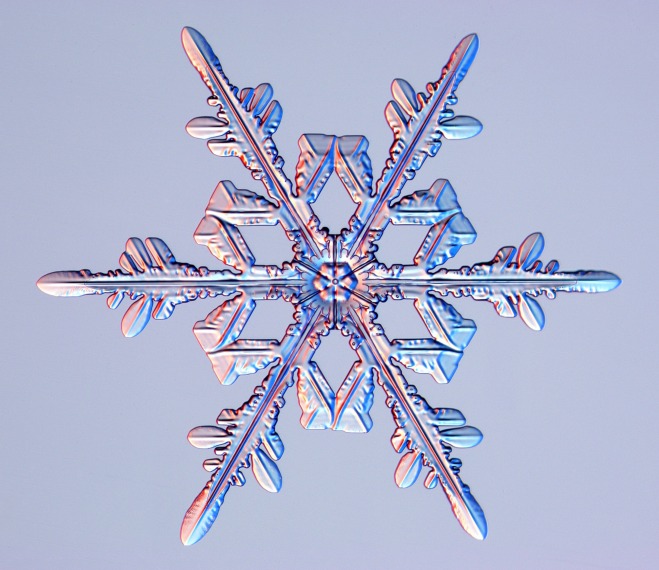
Snowflake Wonder by Elaine Lockey

http://weather.thefuntimesguide.com/2009/01/the_snowflake.php
If you get caught outside finishing up gardening tasks when it begins to snow, chances are you aren’t too interested in stopping to admire it.  But when you have the opportunity, “snowflake watching” will transport you right back to your childhood sense of wonder.

Snow crystals are single crystals of ice while a snowflake is one or more crystals stuck together. Water molecules create a hexagonal lattice that is formed when water vapor condenses directly into ice in clouds when the temperature is freezing or below. There are several factors that influence the shape of snowflakes: humidity, temperature, and air currents.  Colder temperatures create more intricate shapes – sharper tips and more branching.


It is commonly believed that snowflakes are perfectly symmetrical.  This is much more the exception rather than the rule.  Snowflakes are generally lob-sided and irregular. Symmetrical ones just tend to be photographed more! Snowflakes always have six sides or six points due to the shape and bonding of the water molecules.

You’ve probably heard that no two snowflakes are alike.  This is more or less true. No two snowflakes are exactly alike down to their molecular level, however it is possible that there could be two visibly matching patterned flakes at some time if the environmental conditions for their growth were the same, although that is hard to fathom. William A. “Snowflake” Bentley (1865-1931), a self-educated farmer, spent years photographing snow crystals, capturing more than 5000 during his lifetime.  His first snow crystal was photographed in 1885. He never was able to capture the same snowflake pattern twice. Snowflakes come in all different sizes too. Guinness World Records lists the largest snowflake as found January 1887 in Fort Keogh, Montana with one allegedly measuring 15 inches wide and 8 inches thick! That must have been quite a snowfall to see.

Snowflake watching is easy to do.  Take a piece of black construction paper and head outside to see what kinds of flakes you can gather on it. The black background really helps the flakes show up.  Some snow days produce more interesting flakes than others so be patient.  An inexpensive magnifying glass can really enhance this activity. 

There are many different types of snow crystals, but the most commonly known ones are the stars, dendrites (my favorite), columns, plates, capped columns, needles and irregular forms. A quick internet search will yield images of these various types. See if you can group the snowflakes that you see into these categories. What’s your favorite type?

I find that a good snowstorm does wonders for my ability to write and read.  Writer Nathaniel Hawthorne felt the same way. “Snowflakes” collected in Twice-Told Tales, 1837, is a wonderful read as the snowflakes come down. http://www.islandnet.com/~see/weather/arts/snowflakes.htm 

Snowflake photographs used with permission of snowcrystals.com

Tuesday, November 30, 2010

Fall and Winter Watering by Donna Duffy


We are on track for one of the warmer autumns on record. In addition, we know that Colorado winters can have long spells of dry, warm and windy weather. During the cold weather seasons, pay special attention to weather and soil conditions and provide supplemental water to keep the root systems of trees, shrubs, lawns and perennials alive and healthy. Here are some tips to help them survive the winter.


General Tips
Apply water in mid-day when the air and soil temperatures are above 40°F and there is no snow cover. If the root systems don’t receive adequate water, the plants could appear normal in the spring, but may be weakened and die off in the summer when temperatures rise. Lack of winter water may also create insect and disease problems. Whenever you water, remember to disconnect the hose when you are finished!

Trees
Newly planted trees are most susceptible to winter drought injury. All trees utilize water most effectively when it is allowed to soak into the soil to a depth of 12”. Whether you use a sprinkler, deep root watering device or soaker hose, be sure to apply water to many different locations below the tree and beyond the canopy of branches. Trees need 10 gallons of water for every inch of trunk diameter (measured at knee height). If you use a deep root needle, insert it only 6-8” below the ground – if it’s deeper than that, it’s out of reach of the tree roots.

Shrubs
Even established shrubs will benefit from winter watering in dry years. Apply five gallons of water for small shrubs (less than 3’) and 18 gallons for larger shrubs. If the shrubs are newly planted, water twice monthly. Mulching the shrubs will help them retain moisture.

Roses and Other Perennials
If you planted perennials in the fall, they probably didn’t have much time to establish a strong root system and they will need winter water. Water when the ground appears dry by checking the soil condition 2-3” deep.  All perennials that are in a windy or southwest location will benefit from supplemental water. Keep an eye on the mulch around your perennials, it’s often blown around in the winter and will need to be put back in place or supplemented.

Lawns
Lawns can suffer winter damage as well as trees, shrubs and perennials, especially newly established lawns. These new lawns will need supplemental winter irrigation following the general tips above. During dry winters, lawns are more susceptible to winter grass mites and dessication if occasional winter irrigation is not applied.

Thursday, October 14, 2010

When Frost Threatens – Take Action by Patti O'Neal

Frost can signal that the end of the gardening season is near – but not necessarily over.
I have a good friend who recently said “I am sick of the garden – I just want it to be over.”  If this is you, then when frost threatens, by all means do a final harvest of the tenders and call it done.  If it’s not you, there are many measures you can take to protect your crops from a killing frost incident, as more times than not, such an incident is followed here by an Indian Summer and at least another month of flower and vegetable enjoyment and harvest.

What is Frost?
Frost is water in the form of dew which freezes on the surfaces of your plants and causes the water in the plants cells to freeze and burst, thus killing the plant.

There are two types of frost, advective and radiation.  Advective frost occurs when a cold front sweeps into an area accompanied by gusty winds, sometimes with clouds and a thick layer of cold from the ground up.  Radiation frost happens on crystal clear days or nights and not accompanied by wind.


Watch the Weather Forecast
As gardeners, watching the weather is akin to new parents listening to the baby monitor.
We are maniacal about it. We know that the average first frost date for our area is October 15.  The first average frost date is the day when there is a 50% chance that a frost will occur.  This will vary by 4-5 days the farther south you are in the county and the higher up the mountain you live. Knowing this, keep a sharp ear to the weather forecasts.  When the weatherman predicts a cold front following clear nights and low humidity, frost is eminent.

Freeze is defined as 32 plus degrees, light frost, damage depends on the duration of the frost and the humidity present. Light Frost is from 29-32 degrees, tender plants are killed with little effect on the other vegetation. Moderate freeze is 25-28 degrees, damage to most vegetation with heaviest to fruit blossoms and tender plants. Hard Freeze is 24 degrees and below and considered a killing frost – thus ending the season.

 Evaluate Your Garden
Decide how much of the tender produce you have left to  harvest and how much frost tolerant produce will need protection.   Learn the difference so you will no be caught unaware. All vegetables and flowers react differently to frost.
Tender Vegetables – Need protection and diligence when frost threatens; will not live below 32 degrees: tomatoes, beans, cucumbers summer squash, annual flowers, annual herbs, peppers.
The Frost tolerant- Can live when vines, leaves are frozen; can survive temps of 28 degrees and sometimes below; the cruciferous vegetables, cabbage, Brussels sprouts, broccoli, hardy perennial herbs like chives, sages, beets, carrots, winter squashes and pumpkins.
The Cold Hardy– thrives in temps between 32 and 28 degrees with some protection.  Flavors tend to improve with the cold: kale, spinach, lettuce, arugula, and chard.


Cover Your Plants 
When frost threatens, we grab just about anything we can to cover our plants.  Covers can provide up to 5 degrees of extra protection.  The best are of woven type fabrics as opposed to plastic or paper, which can do a fair job, better than nothing, in a pinch. The smartest way to apply a frost protection cover is to support it slightly above your crop or tree or container garden with hoops or stakes.  This creates an air pocket which buffers the temperature drop.  It should be high enough so that the weight of any precipitation that occurs will not touch the plant.  Wet fabric can cause the same damage when touching your plant as if the moisture had settled directly on lit.  Don’t forget to remove the covers in the morning before the sun comes out.

Irrigate Well Before a Frost
Plants go into a frost much more successfully when the soil around them is moist as opposed to dry.  Moist soil holds four times as much heat as dry soil.  Moisture also conducts heat to the soil surface by as much as 5 degrees and that difference is maintained into the early morning hours.  So, water your plants well the evening before an expected frost. 

We are into October and our fickle Colorado weather could spring a frost on us at any moment and then nothing for weeks.  It behooves you to protect your plants to reap weeks more of enjoyment of color and harvest.  These tips should help you to do that so that you can continue to enjoy our amazing fall with the confidence that your plants will succeed as well.

Thursday, October 7, 2010

Raspberry Comeback! by Gardener Cumax


Raspberry canes 2 days after the July 21, 2009 tornado
Over the past week the raspberry canes have been going nuts. It’s very heartening to see because last year the canes were stripped and damaged by the weather even that shall not be named. They didn’t look any better in the Spring.

I bring this up because a fellow master gardener once said that pruning raspberries in the Fall or earlier would result in fruitless canes the next year. That alone made me consider, for a brief second, to plant anew. 

But the part of me that has learned to trust Nature to see what will happen won over.  It always does. I love gardening some times for no other reason than to experiment with plants and see what happens.

And what a happening! Bees have been pollinating it like nuts. Between that the Russian Sage (Perovskia atriplicifolia), the bees deserve all the credit for a bumper crop of berries.
4'+ canes bend over from the weight of their berries. September, 2010
Speaking of berries, some of you master gardeners might be aware of Panayoti Keladis’ friend Steve Miles of Boulder. Steve has a one of the best cacti and succulent gardens around.

Unnoticed among the immense number of cacti species is a huge thornless blackberry bramble in his back yard. Most years the cane reach 20+ feet. This year it was shorter vines but much more fruit.

I had the opportunity last Saturday to get back up to Steve’s place. While the Hill slumbered I got busy and harvested a ton of big black juicy nuggets. Those that were too ripe fell right into my pie hole. The rest came home to share with friends.

Now here’s the weirdest thing about those blackberries: Steve has lived there since before the blackberries. It’s 5 blocks from Chautaqua Park, which is prime bear territory. In all these years the bears have never found those blackberries. Maybe they don’t like them, and maybe trash tastes better. There’s nothing like fresh berries from the vine.

What to eat? Just head to the garden and eat there!
Note: I continue to use Neptune’s Harvest Fish Fertilizer on everything. That’s part of the reason the raspberries came back better than ever before. 

Friday, October 1, 2010

Preparing Roses for Winter by Donna Duffy


It's October!  Ready or not, winter really will be here soon. Among all of your other fall garden chores, be sure to plan some time to get your roses “tucked in” and ready to brave whatever winter may bring. According to the Denver Rose Society’s publication “Growing Roses in Colorado,” there are five basic steps to remember.


FIRST – Pick up and discard all the leaves that have fallen from the rose bushes. This is especially important if you have had mildew and/or blackspot. You can repeat this step in another month or so, when the roses are truly dormant and more leaves have fallen. This simple sanitation practice will decrease the likelihood of having the problem recur next year.

Rose Hips

SECOND – You can stop deadheading your roses at this point. Some roses develop colorful hips after the last bloom, and you’ll miss them if take off all the spent blooms. In Colorado, it’s best to wait for Spring to do heavy pruning of roses. If you have some rose canes that are taller than 3’, you could top them off to prevent them from rocking in the wind or breaking off in heavy snow. Save any additional pruning for springtime.

THIRD – Water your roses well before the ground freezes. Watch the weather: if the temperature is likely to drop below 25 degrees, get the roses watered. Roots will suffer more from cold temperatures in dry soil than in damp soil.

FOURTH – Keep watching the temperature. When it drops to about 22 degrees in your yard for a few nights, it’s time to cover the crown area of each bush with a few shovels full of soil. Add mulch for additional protection. If you live in a windy area, you might use a rose collar to hold the mulch in place (purchase them at garden centers).

Rose Collar

FIFTH – Check the roses for moisture content every couple of weeks during late fall and winter. If the temperature will be 45 degrees or warmer for six hours, watering can be done. Dig down with your trowel for 4-6 inches to test the soil moisture.

AND IN THE SPRING…don’t be overly anxious to scrape off the mulch and prune the rose canes! Watch this blog for Spring pruning information. 

Thursday, September 9, 2010

The Impact of Sun on Veggie Gardening by Gardener Cumax

Note: this is the second in a series of blogs by Gardener Cumax. You might also want to read "The Impact of Soil on Veggie Gardening" posted on 8/28/10. 
Given that I've been fertilizing, the next variable is Sun. My garden is blocked from early morning sun by a huge silver maple tree. It's not until 11:30 am that the center of the garden gets full sun, and not until 1:00 pm that the area closest to the tree gets full sun.

Applewood Community Garden, on the other hand has no obstructions whatsoever. It's in full sun from the get go. Why early morning sun matters: that's what veggies need! Applewood gets sun from the get go! Put it this way: my garden is missing at least 5 hours of direct sunlight each day.

My intuition tells me that those 5 hours make a difference in plant and soil health. Instead of watering in the morning or evening - except containers which need it both; and 3 times during temps above 93 - I have to water at noon for daylight growing plants; nightshades I water near sunset anyways.

Another factor comes into play: the monsoon season has been in full swing for a couple of weeks now. It's common for it to cloud up before 2:00pm, meaning my veggies get 2-4 hours of direct sunshine. This simply is not enough.

The difference can be profound.
The tomatoes keep right on growing and flowering in September. That's what indeterminate means. The vines are now 7' tall.
One interesting thing is that while my greenhouse has its roof halfway open, the walls greatly limit wind desiccation. The tomatoes and peppers in there are doing fantastic in spite of the same amount of sun time. I believe that the partial roof, which is a greenhouse film, is dispersing the sunshine, so in a way it's making more light available for the plants inside it than those just outside it.

Coming next: The Impact of Water and Timing on Veggie Gardening

Thursday, August 5, 2010

Hot Weather Garden Problems by Carol King and Donna Duffy

The Dog Days of summer are here. The Greeks and Romans believed the dog star Sirius, a prominent star in the August heavens,  was the cause of the hot, sultry weather. They considered this to be an evil time "when the seas boiled, wine turned sour, dogs grew mad, and all creatures became languid, causing to man burning fevers, hysterics, and phrensies" according to Brady’s Clavis Calendarium, 1813.
It’s also the time in the garden when hot weather causes all sorts of calamities as well and gives gardeners fevers, hysterics and phrensies!  Be on the lookout for these problems.

The lawn is getting brown! The lush green grass from spring is starting to dry up with the hot days. If your lawn is Kentucky bluegrass (very common in landscaping) this slowdown is a natural part of the life cycle. Tip #1: mow to a height of 2.5 to 3”, and return the mulched clippings back to the lawn. Tip #2: fertilization is typically not necessary from July to early August. Wait to fertilize until late fall while the grass is still green. Tip #3: when a lawn looks thirsty, a common mistake is to increase the watering time. When using a standard sprinkler system with pop-up heads, eight to ten minutes is about the optimal time any one turf zone should run so run-off doesn’t occur. The full cycle may need to be repeated two or more times depending upon rain, humidity, wind and heat in the environment.

Yikes! Spider mites! Spider mites are common pest problems on many plants around yards and gardens in Colorado. Damaged areas typically appear marked with many small, light flecks, giving the plant a somewhat speckled appearance. You might also see webbing. Tip: few insecticides are effective for spider mites and many even aggravate problems. Instead, try a periodic hosing of plants with a forceful jet of water to physically remove and kill mites, as well as remove the dust that collects on foliage and interferes with mite predators.

Leaf scorch. During the hot days of summer, many trees, shrubs, flowers and vegetables develop dry, brown leaf margins. Once leaf scorch has occurred, there is no cure. The dehydrated portions of the leaf will not turn green again, but with proper water management, the plant may recover. Tip #1: during the growing season, water deeply and infrequently. Resist the urge to water more frequently. Tip #2: in the winter, give the plant a deep watering once a month when there is no snow cover. Tip 3: avoid overfertilizing. Fertilizer spikes, that deliver concentrated salts at specific sites, can burn roots and contribute to leaf scorch.

Pollination issues.  Many summer vegetables must be pollinated by insects such as bees to set fruit, During hot weather, pollen doesn’t remain viable very long. As a result there may be a drop in vegetable production for several days during and after hot spells even if bees are present. There may be more misshapen fruit as a result of poor pollination.

Blossom drop. Temperatures in the nineties cause many vegetables to drop their blossoms before fruit forms. Squash, zucchini, tomatoes, and beans are especially prone to this. Over fertilizing and under watering also contribute to blossom drop. Tip #1: To minimize blossom drop during a heat wave, keep your garden well watered by applying around 1” of water per week if it does not rain. Tip #2: avoid high nitrogen fertilizers.  Tip #3: Mulch the vegetables to conserve moisture and keep soils cool.

Blossom end rot. Another problem that is common in hot weather is blossom end rot (BER). This disorder occurs when there is not enough calcium available to developing fruit, resulting in the lower end of the fruit turning tan or black and failing to develop. BER is most common in tomatoes, but also occurs in eggplant, peppers, watermelons, and squash. The most common causes are uneven watering, over fertilization, extreme temperatures, and low soil pH (acid soil). Tip #1:  keep vegetables evenly moist. Do not allow them to dry out during dry spells. Tip #2: do not over fertilize with high nitrogen fertilizers.

If you have other “phrensies” in the garden, call the Jeffco CSU Extension Office at 303-271-6620.  We’ll get through this together!

Saturday, July 31, 2010

U.S. Farmers Cope With Roundup-Resistant Weeds

 As weeds  become more and more "Round-Up" resistant, what's a farmer to do?  Read this article about this growing problem in the farming community.  It will no doubt eventually affect the home gardener as well.


U.S. Farmers Cope With Roundup-Resistant Weeds - NYTimes.com

Thursday, May 13, 2010

How to properly prune damaged branches

While Ft. Collins and northern Colorado bore the brunt of the heavy snow,  some of us in Jefferson County no doubt lost limbs.  Here's an article from Ft. Collins that will be helpful in pruning those damaged trees and shrubs.  Now let's hope we don't have to discuss this subject again until late fall!!

ck
 

How to properly prune damaged branches | coloradoan.com | The Coloradoan

Monday, May 10, 2010

How to protect your early spring garden from a late snow storm -


"Tis a privilege to live in Colorado" - F Bonfils

Here's the prediction straight from NOAA: 

A STRONG SPRING STORM WILL MOVE INTO SOUTHERN UTAH TUESDAY
AFTERNOON...AND THEN TRACK ACROSS COLORADO TUESDAY NIGHT AND
WEDNESDAY MORNING. PRECIPITATION IS EXPECTED TO DEVELOP IN THE
MOUNTAINS TUESDAY...AND THEN SPREAD ACROSS THE PLAINS TUESDAY
AFTERNOON AND NIGHT. HEAVY SNOWFALL IS POSSIBLE ESPECIALLY OVER THE
FRONT RANGE MOUNTAINS AND FOOTHILLS. IN ADDITION...TEMPERATURES MAY
BE COLD ENOUGH TO BRING SNOW INTO THE URBAN CORRIDOR AND PORTIONS OF
THE PLAINS AS WELL...ESPECIALLY LATE TUESDAY NIGHT INTO WEDNESDAY.

THERE IS STILL CONSIDERABLE UNCERTAINTY WITH THE TRACK OF THE
STORM...AND ANY VARIATION TO THIS TRACK WILL HAVE EXTREMELY LARGE
IMPLICATIONS ON TEMPERATURES AND THE AMOUNT OF SNOWFALL AT ANY GIVEN
LOCATION.

Here's a great site with helpful information for protecting your plants tomorrow night!

How to protect your early spring garden from a late snow storm - by Rex Trulove - Helium

Thursday, April 22, 2010

Welcoming the Peach Blossoms by Heirloom Fan


After the devastating hailstorm which hit in the middle of the summer last year, I wondered how the trees, bushes and perennials would handle that type of trauma and still survive. After the storm, like many people, we found our trees had sustained damaged such as snapped branches and even part of the bark “skinned” on the branches and limbs. I wondered not only what this would mean to the health of the tree last year but what would happen after it went through the winter dormancy and if we would see a good recovery in the spring.


Luckily today, I saw one of the first glimpses of how nature can recover after an event like this as I see my peach tree slowly begin to open its flower buds. Even better, there were several bees that were making their way to the open blossoms. These small, dark, shiny bees were most like orchard mason bees, which are extremely beneficial for fruit production and are non aggressive.


As I began checking the tree a few weeks ago, I also noted that most all of the limbs and braches did have leaf and flower buds, including those that had sustained damage. I purposely did not do pruning on my peach tree this spring just to see how many of the branches would show recovery and so far, I can say that it looks very promising. I found that even some limbs that had damage in spots, still seemed to “work around” that damage and produce the leaves and blossoms in the non injured areas.

There are also other bushes and trees that are not yet ready, such as the lilac so the progress and recovery of each of these will be closely watched. Last year, after the hailstorm, a very odd occurrence happened where trees and bushes re-bloomed midsummer. To see a lilac in full bloom the first week of August was strange indeed and showed the extent of the trauma that these plants endured.

I am hoping for the best and will be reporting on what I see as we go along this spring.

Tuesday, January 5, 2010

Gardening in Winter

Think you can't garden outdoors in winter? Think again! Garden Girl gives us some useful tips for raising some cold weather vegetables in the snow.


blogger templates | Blogger