tattoos
Showing posts with label Mary Small. Show all posts

Saturday, April 16, 2011

Pest Problems Abound After a Dry Fall and Winter by Mary Small

We’ve sure had a dry fall, winter and early spring! And alas, as I write this, I can hear the wind roaring outside.  Our persistent dry, warm, windy weather has stressed plants and this will make them susceptible to disease and insect pests in 2011. Many tree care specialists think there will be a lot of damage this year.

Here are a few problems we can expect to see:
CSU Extension

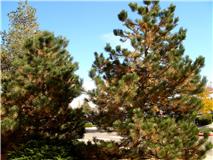
Winter burn on evergreens. 
In fact, you can see it now. Look for brown needles, particularly on the south or on the windward side of the plant. Needles will be uniformly brown from the tips inward.  It’s the result of our dry, warm, windy weather that promotes transpiration, water loss through the needles. This isn’t a problem until there’s not enough water in the soil to replace what gets lost. Sometimes, though, water loss happens so fast (like on windy days!) that plants  cannot keep up with it. Needles lose so much water so fast, they dehydrate or “burn”. 
Little can be done at this point, except to water plants and hope for rain or snow! This spring’s new growth will mask most of the brown needles which will eventually fall off. Winter burn does not usually kill established plants, but may seriously damage younger ones.

University of Minnesota Extension

 Cytospora canker. 
A common fungal disease found on many trees and shrubs.  While the problem is a common one, we will probably see more because of weather stresses.  This pathogen is a weak one and only successfully damages plants stressed from something else, like drought. Look for dead or poorly leafing branches this spring and examine them more closely for sunken, discolored lesions.  These are the cankers. Prune damaged branches off below them. Water trees every 2-4 weeks if there’s no significant snow melt or rainfall.  For more information on Cytospora canker management strategies, see fact sheet 2.937, Cytospora Canker at http://www.ext.colostate.edu/pubs/garden/02937.html  

Barkbeetles.org

Borers and bark beetles that attack stressed plants. 
When trees are stressed, they produce chemicals that can attract certain insect pests. An example of this is the spruce ips beetle. Spruce ips beetles feed in the conductive tissue under the bark, causing needle and branch death. They are typically found in the upper portion of mature trees. They also damage recent transplants.  Actively growing, healthy trees are more resistant to insect pests.  Promote  plant health by watering during dry periods, but avoid over-irrigation as that  stresses trees, too.  Insecticide treatments may be applied to trunks just prior to the time when adults fly and begin laying eggs in the spring.  For more information on ips beetles see: http://www.ext.colostate.edu/pubs/insect/05558.html

Friday, November 12, 2010

Needle Drop in Evergreens by Mary Small


Spruce trees are getting a lot of attention this fall. Their inner needles are turning yellow or brown and dropping off. 

To put your mind at ease, it’s not unusual for these conifers to shed interior needles beginning in late summer and continuing well into fall.  This is normal evergreen behavior.

In fact, all conifers (“evergreens”) including spruce, pine, fir, juniper and arborvitae lose their oldest needles every year. Contrary to what the name implies, “evergreens” are not really green forever. Their needles generally have a 2–4 year life span, although spruce trees live about 5-7 years. 


While needle loss occurs every year, the process is usually gradual, over a period of several weeks or even months, depending on species and weather. It’s so gradual, that you might not even notice the needle drop.

Some species can shed needles in a fairly short period of time, making it look as though they’re in serious trouble. And environmental problems, like drought, can make needle drop happen more quickly than it would if the tree was healthier. 

That’s what’s wrong with the spruce this year.  August and September were low moisture months, with most Denver metro locations receiving only a trace of precipitation after early August.  These dry conditions stressed conifers, particularly spruce, which prefer moister conditions than we experienced.

There is no need to treat evergreens for the condition.  This fall and winter, ensure all evergreens are irrigated monthly in the absence of rain or snowmelt. Apply water so it reaches the absorbing roots.  For established plants, these are located a distance of two to three times the height of the plant away from it. For newly planted trees, apply water to the planting hole and just outside it. Always irrigate when the soil is unfrozen and able to absorb the water. 

Studies show that fall-applied water has great benefit.  Roots are still active and can absorb water as long as soil temperatures stay above 40 degrees Fahrenheit. 

If evergreen needle drop is occurring on outer needles or both inner and outer needles, a closer look is needed.  Branch samples may be brought to the Jefferson County Extension Plant Diagnostic Clinic, located on the Jefferson County Fairgrounds, for diagnosis.  Jefferson County residents will be charged a $7 fee, non-Jefferson county, $10.

Wednesday, November 10, 2010

Fresh or Canned This Year? by Mary Small

In the early years of our marriage this was always the question about the yearly pumpkin pie.  My husband had fond memories of fresh pumpkin pies his mother made.  I did not share them; the one pie my mother made fresh was, in her words, “a disaster.”  So if I made a pie, it was always from canned pumpkin.

This year, my colleague, Carol O’Meara, of Boulder County Extension, asked me to help judge pies made from several different types of pumpkins that grow in Colorado.  I love pumpkin pie, so this was an easy “yes”.  Then I thought back to Mom’s “disaster” and greeted the event somewhat apprehensively.


Our first task as judges was to taste the roasted pumpkin product that later went into the pies.  Some were pretty decent, but there was one that was just plain awful.  Compared to the ones before and after it, the sample was almost bitter.  It was very chunky and not smooth textured.

 The color variation of the different pumpkins was amazing. Our sample plates looked like an artist’s palette.  One pumpkin produced a beautiful rust-colored orange product, while another was a pale, pale yellow-orange.  Some reminded me of butternut squash- gold. 

Winter Luxury Pumpkins
Tasting the pies was mostly yummy, but also eye-opening.  My favorite roasted pumpkin (the beautiful rust-colored one) was okay, but had a funny aftertaste.  The winning pie was made from Winter Luxury, an heirloom variety. No wonder it has stood the test of time! The roasted pumpkin that tasted worst didn’t improve much made into a pie.  It was a bit watery, still chunky and still tasteless.  Turns out it was made from a pie-pumpkin variety! Many of us agreed that variety would deter pie-makers from ever trying fresh pumpkin again.  (Maybe that’s the one Mom used…)

So what did I conclude?  The pumpkin is the pie and some types can’t be improved, not even with cream and spices.  I’ve changed my mind about fresh pumpkin pie. Next year, I think I’ll grow Winter Luxury and give it a try.

For more information about the specific pumpkin varieties used in the tasting, check here at Carol O’Meara’s blog .

Here's the story from the Daily Camera!

Thursday, July 29, 2010

Check Your Tomatoes! Psyllids Have Arrived by Mary Small

Better check your tomatoes!  Tomato/potato psyllids have arrived from the south and are wreaking havoc in area gardens. 

Psyllids are small sap-sucking insects. Their saliva is toxic to tomatoes and potatoes and can cause them serious damage.  Unless you know what you’re looking for and are checking regularly, the insects can go undetected until it’s too late. Here are some psyllid-detecting tips.


Examine the undersides of tomato and potato leaves; that’s where the bulk of psyllids hang out.  Eggs are small, orange-yellow and “ stalked” (held upright by a little pedestal).  See if you can find the yellowish nymphs (young). They look like tiny, plastic flying saucers. Following egg hatch, nymphs crawl around the leaf, looking for a place to settle.  When satisfied with their choice, they hunker down, feed and remain stationary. So they’re not going to jump or fly away while you’re looking for them.

Unfortunately as nymphs mature, they turn pale green, making them harder to detect. Fortunately, psyllids produce easily-seen “psyllid sugar” (a polite euphemism for their  poop).  So if you don’t see the beasts but find sugar on plant leaves, you know they’re around…and feeding!

Unchecked, these insects cause plant symptoms known as  “psyllid yellows”.   Upper leaves turn yellow with a purple tinge to veins and margins.  Leaves become stiff and leathery.  Tomato plants either produce an abundance of tasteless fruit or produce no fruit at all.  Potato plants develop lots of small, weirdly-shaped tubers that may actually sprout underground. Needless to say, the crop is ruined.

So what’s a gardener to do?  Check tomato and potato plants regularly.  Inspect eggplants and peppers, too.  Psyllids can feed on these plants, yet not cause significant damage. Apply insecticidal soaps, sulfur dust (if you can get it coated on the leaf undersides) or insecticides containing permethrin or esfenvalerate.  Always follow label directions when using any of these products.
See this Colorado State University extension fact sheet for more details:
http://www.ext.colostate.edu/pubs/insect/05540.html

Here's an article from the Boulder Daily Camera also.

Tuesday, July 27, 2010

Home Invasion! False Chinch Bugs by Mary Small

Hot dry weather can be a problem for our garden plants, trees and lawns.  But it can also create problems with insects known as false chinch bugs.  And in turn, they cause problems for humans!

False chinch bugs are small, grayish insects that feed on a variety of plants in Colorado including weeds and mustard family crops such as canola and radishes.  They suck sap from plants but are rarely destructive.  Most of the time, we don’t even know they’re around.


But when the weather is hot and dry, the insects move to cooler, moister locations.  They seek shelter in our homes and irrigated landscapes…sometimes thousands at a time!
 In the landscape, they seem to prefer plants that are flowering or going to seed.  Healthy plants can withstand a lot of feeding pressure.  Chemical controls are not recommended during an “invasion” sparked by hot dry weather.  Generally the insects disperse elsewhere in a short time.

Home invasions of false chinch bugs can be disconcerting, but they won’t be there for longer than a week.  Fortunately, they don’t bite or feed on anything indoors.  Suck them up with a vacuum cleaner, disposing of the bag immediately after vacuuming.

For more information on false chinch bugs, see this Colorado State University Extension fact sheet:
http://www.ext.colostate.edu/pubs/insect/05603.html

Thursday, July 22, 2010

Fire Blight Arrives in Our Trees! by Mary Small


As if trees didn’t have enough trouble from last summers’s hail, October’s damaging freeze and a late spring, some have now developed fire blight!  This bacterial disease is common on crab apple, apple, mountain ash and pear. 

Warmer than average temperatures during blossom time creates ideal conditions for disease development. If rain falls at the same time, its spread is rapid.  And guess what?  This spring was just perfect, if you were fire blight bacteria!

Fire blight symptoms can be found as early as petal drop, when infected blossoms shrivel and turn brown.  During the late spring and summer, infected branches wilt and darken as the bacteria colonize them.  Branch tips darken and bend over in a “shepherd’s crook” formation, appearing as though they were torched.  In wet weather, it’s easy to find small blobs of cream colored bacterial ooze on infected tissues.  Branches and trunks also develop cankers, areas of sunken discolored tissue.  

Fire blight bacteria spend the winter in the canker margins until warm, moist spring weather stimulates bacterial growth and oozing.  Insects carry the ooze to flowers where the bacteria reproduce quickly in the sugary nectar.

Bacteria also spread through splashing water into natural openings and wounds created by hail, insect feeding and pruning.  We’ve seen a great deal of fire blight this year on crabapples damaged by last July’s severe hail storm.

Prune out the damaged branches.  Make pruning cuts 8 to 12 inches below visible signs of infection.  Surface sterilize pruning tools with bleach, ethyl alcohol or disinfectant sprays after each cut to avoid spreading fire blight on pruning tools. 

Local weather conditions determine disease severity each year.

Check out this CSU Extension fact sheet for more information.

Sunday, July 11, 2010

Recent Plant Diseases in Jefferson County by Mary Small

Cool moist spring weather contributed to the development of oak leaf blister, a fungal disease.  Infected leaves develop light green blisters or bulges that later turn brown.  The problem often goes unnoticed until leaves drop prematurely beginning in mid summer. 
While unattractive, tree health is not usually affected. However, yearly infestations of oak leaf blister can weaken a tree, making it more susceptible to other problems.  Maintain good tree health.  In fall, rake up fallen leaves and dispose of them.

Moist spring weather also contributed to the appearance of rose rust.  This fungal disease causes orange pustules to form on leaf undersides.  Leaf surfaces initially have orange-colored spots superficially resembling drops of paint.  As the pustules enlarge, spots turn brown.  Infected leaves may drop.
When a rose has the leaf symptoms, also look for black crusty growths on canes (which are overwintering fungal structures) and remove the canes. If not done already,  prune roses to increase air circulation within the leaf canopy.
Moisture management is essential to minimize this disease, so water early in the day to dry leaves quickly.  In the fall, clean up leaf debris from around infected plants
A few fungicides are available for rose rust management but must be applied when conditions are conducive to the development of the disease: moderate temperatures and wet leaves.  Products available for rust management include potassium bicarbonate, mycobutanil, propiconazole and sulfur. Fortunately, hot dry weather stops disease development.

Wednesday, July 7, 2010

Herbicide Injury by Mary Small

We have been blessed by an abundance of rain this spring.  It’s been great, not only for our gardens, but also for those pesky weeds.  Just as there are a variety of weeds, there are a variety of ways to manage them.  One of the most common methods is spraying them with herbicides (weed killers).  When used according to label directions, herbicides are quite successful.  However, some users fail to read the directions and that’s when problems occur.
We’ve started to see herbicide injury to garden plants in the CSU/Jefferson County Extension plant clinic.  Growing tips are twisted and curled; leaves may appear twisted, cupped or narrower than normal.  Leaf stems (petioles) may be twisted or curled.  Garden plants such as tomatoes, beans and lilacs are very sensitive.  Unfortunately, herbicides don’t “know” the difference between a desirable and an undesirable plant.   And it doesn’t have to be you that applied the product; herbicides can move from their target area (ie, a lawn) under the right conditions.
What can you do to avoid problems with herbicide injury? 

Watch the air temperature.  High temperatures (85 degrees or higher) during or right after application can cause some products to vaporize and move elsewhere (called “drift”).
Watch the wind speed.  Don’t apply products when it is windy or breezy.  Early day applications are often best to avoid “drift” from wind movement.
Use lower pressures or sprayer nozzles with larger openings that will increase the droplet size and make it more difficult for the product to move elsewhere.
Hold the sprayer nozzle as close to the plant as the product suggests so it doesn’t have a chance to become airborne.
Distortions or weird growths you find are not always  the result of herbicide injury.  Weather, soil problems, root stress, diseases, insects, mites and mutations can also cause these problems.  Have the problem checked out by the CSU/Jefferson County plant clinic.  We can’t test for herbicides in plants, but we can look for other problems.  The clinic is located on the Jefferson County fairgrounds in the Extension office.  There is a $7 fee for Jefferson County residents and a $10 fee for non-county residents.

Saturday, July 3, 2010

Viburnum Bacterial Blight by Mary Small

If your viburnum leaves are sporting brown and yellow speckles, better get out the pruners!  These leaves are infected with Pseudomonas blight, a bacterial disease.  Cool moist spring weather is partially responsible for its appearance this year.
The disease over-winters on buds and twigs.  During springs like we just had, bacteria is splashed from the wintering sites to the leaves, creating brown, angular spots often surrounded by a yellow “halo”.  In severe infections, leaves become distorted and twig tips may die.
Prune out the damaged areas, disinfecting your pruning tool between each cut with rubbing alcohol, a 1:9 bleach/water solution or a disinfectant spray.  The treatment helps prevent accidental bacterial introduction to healthy tissue.
Also take time to thin or prune the affected viburnum so there is better air movement in the canopy of the plant- which also helps reduce infection.

Thursday, July 1, 2010

Iris Leaf Spot by Mary Small

Cool moist spring weather is partially responsible for the appearance of iris leaf spot, a fungal disease.  Leaf spots are most noticeable on the upper half of iris leaves.  They are oval-shaped with tan to gray centers and red-brown borders.  During summer, infected iris leaves may die back prematurely from the tip.

This fungus over-winters on dead leaves and stems, so one way to reduce the problem is to clean up the garden in the fall. This removes infected plant material which reduces the amount of fungal matter in the garden next season.

 Dig and replant iris (about 6 weeks after blooming) to keep them from becoming crowded.  Close plantings encourage poor air circulation which creates good growing conditions for the fungus.  Crowded plants also make it easy for fungi to splash from plant to plant, spreading the disease.

In most cases, good cultural practices (fall cleanup and plant thinning) keep the problem low in our western climate.  Fungicides are rarely needed.

Monday, June 28, 2010

Trees Not Leafing? Here's Why by Mary Small and Robert Cox


    Many Front Range trees and shrubs are not leafing well, leafing slowly or appear to be dead.  A number of these were injured by the severe cold snap last October 8-9, 2009. The damaged plants had not fully “hardened off” when temperatures took their sudden drop.  (Hardening off is a natural, gradual process that prepares woody plants to survive cold winter temperatures.) 

In some cases, affected plants were already stressed by environmental conditions and predisposed to further damage from the cold. Numerous ash were already struggling with “ash decline” or borers.  Some catalpas had verticillium wilt, a fungal disease that attacks conductive tissue and weakens plants.
 Trees and shrubs that received late summer or early fall irrigation and nitrogen fertilizer remained succulent rather than hardening off and were more prone to cold injury. 

 A significant amount of dieback has been observed on rose, spirea, blue mist spirea, honeylocust, crabapple, ash, Amur maple, red oak, catalpa, hackberry and others.  Some trees with dead tops are just now pushing shoot growth from latent buds in the trunk. Any trees showing this type of growth will generally not develop into strong landscape trees and should probably be removed. 


For more information, call the Jefferson County, CSU Extension at 303-271-6620.

Friday, March 12, 2010

Watch Your Lawn for Snow Mold by Mary Small

Many lawns in the Metro area have symptoms of gray snow mold.  The damage appears as circular patches of matted, discolored grass. 

Snow mold is a fungal disease that develops when snow falls on unfrozen turf and remains there for long periods of time. The most severely damaged grass is found adjacent to driveways (where large piles of snow accumulate from shoveling) or where there are snow drifts.  Snow mold fungi thrive in temperatures just above freezing, conveniently provided by the long-lasting snow cover!
As snow recedes, circular patches of light yellow, straw or brown-colored turf suddenly appear.  The grass blades in these patches are matted and may be covered with gray or white webbing.  As the grass dries out, webbing disappears and the patches crust over.  Grass blades may be killed if infestations are severe.  When temperatures warm, new leaves develop and the lawn begins to recover.  Damaged grass may be a bit slower to green up.
Although infections begin in winter under snow, fungal growth may continue after snowmelt if the grass remains cool and wet.  Once temperatures regularly exceed 45 degrees or the lawn dries out, gray snow mold activity stops.

To manage snow mold, rake the patches to break up the crust and dry out the lawn.  You can follow this with a light fertilizer application in early spring.  Fungicides are available, but must be applied in the fall.

Fortunately, snow mold infestations don’t happen every year. Environmental conditions must be just right for the disease to occur and piles of long-lasting snow aren’t that common in the Metro area.

Friday, October 9, 2009

Mountain Pine Beetle Different in Urban Areas by Mary Small

For about three years, mountain pine beetle has been found in the urban corridor.  Arborists and city foresters have been watching the hit trees carefully and are taking steps to keep the pest contained. What they’ve learned is that MPB behaves differently in the city than in the forest. In the urban setting, most of the trees with beetle hits are Scotch pine. A much smaller percentage include ponderosa pine and other pine species. Even with lodgepole or ponderosa pine nearby, the insects heard for Scotch pine!


Ralph Zentz, city forester in Fort Collins, calls this distinct attraction to Scotch pine a fatal one for the beetles. These pines produce copious amounts of resin and are usually successful in “pitching out” (and drowning) the beetles. In most cases (in Fort Collins, about 90%), pines that have been hit by beetles actually survive the attack. In the forest, these pines would be considered “goners”.

Trees in urban settings are usually watered more thoroughly or more often than their counterparts in nature. Trees use the water as a component of the resin, so more water equals more resin and more resin equals more successful pitch-outs. There is less competition for resources in the urban setting than in the forest, producing a healthier tree (they aren’t spaced so closely). Many pines are also treated for a variety of pests.  Some of these applied chemicals may help protect them from MPB.
At this time, there is a low-level epidemic in ponderosas along the Front Range. They are found most-
ly in lower elevations, but closer to town than the lodgepole pines of higher elevations. More com-
munities are reporting MPB presence than in past years. Foresters believe that the newer infestations
are coming from the infested native stands, wood stockpiles or other, unidentified infested trees in our
communities. It’s a good bet that a lot of beetles are inadvertently brought in on firewood.

As Master Gardeners, here are the messages we need to communicate to our urban citizens:


  • Don’t transport infested firewood.  Non-infested trees are “red (needles) and dead”.  Green and fading trees are not okay!


  • Remove only trees that have been successfully attacked.  It may not be possible to tell that until February or March. Successfully attacked trees will generally have air holes above the pitch tube sites about every 6 inches; woodpecker activity; loose bark; long vertical galleries packed with frass under the bark; blue stain; and horizontal larval galleries under the bark. 


  • There are no curative treatments, but preventive sprays may be applied in May or June. They include carbaryl, permethrin (Astro) or bifenthrin (Onyx).  It’s best to have an arborist make the pesticide applications.


  • Saturday, September 12, 2009

    Catalpas Crashing by Mary Small


    The Jeffco Clinic, Arapahoe County Extension and a number of tree care companies have been fielding questions about failing catalpa. Leaves turn chlorotic, then wilt, turn brown, shrivel up and drop. In some cases, internal streaking is found in small twigs. Often, only one portion of the tree is damaged, while the rest looks normal (a healthy Catalpa is shown in the photo).


    In consultation with Dr. Ned Tisserat, extension plant pathologist and Dr. Bill Jacobi, professor of plant pathology at CSU, it appears the problem is verticillium wilt. This fungal disease infects the conductive tissue, causing the symptoms described. The cool and moist weather this year was conducive to the development of verticillium wilt. One of the most confounding things about this disease is that the internal streaking caused by the fungus does not always have to be present. It is also difficult to culture. There is no chemical control for verticillium wilt. Branches that are dead should be removed and disposed of. Branches that show slight wilting should be left on to see if they recover. If a plant dies from verticillium, replace with resistant varieties such as conifers.

    For more information about verticillium wilt, see pg 142 of Insects and Diseases of Woody Plants of the Rockies.

    Tuesday, September 8, 2009

    Plant Alert: Giant Hogweed by Mary Small

    Recently I was directed to an on-line article in which a popular local author recommended the use of Giant Hogweed (Heracleum mantegazzianum) as an exotic ornamental. While an unusual and attractive plant, it is on the Federal noxious weed list - for very good reasons. If moist skin (say from perspiration) contacts plant sap and the affected area is exposed to sunlight, painful, burning blisters result. Some people develop painless red blotches that turn into purplish or brown scars that can persist for several years. If sap should get in eyes, temporary or permanent blindness can result.


    Giant hogweed crowds out native species in various ecosystems including streams/rivers and disturbed areas. It prefers moist soil. Here’s a description of the plant taken from this King County, Washington web site: “A member of the parsley family, its most impressive characteristic is its massive size. It reaches a height of 10 to 15 feet when in flower and has hollow stems, 2 to 4 inches in diameter with dark reddish-purple spots and bristles. Coarse white hairs at the base of the leaf stalk are also purplish, and each purple spot surrounds a blister-based hair. The deeply incised compound leaves grow up to 5 feet in width.


    Giant hogweed flowers mid-May through July, with numerous white flowers clustered in an umbrella-shaped head that is up to 2.5 feet in diameter across its flat top. The plant produces flattened, 3/8-inch long, oval dry fruits that have a broadly rounded base, and broad marginal ridges.” It has not yet been found in the Colorado countryside, nor is it in an adjacent state. It is similar in appearance to cow parsnip (Heracleum maximum or H. lanatum), which does grow in Colorado. However, cow parsnip does not have purple blotches. In the author’s Colorado garden, it grows to about 6 feet with a 4 foot spread. Management of giant hogweed requires persistence regardless of the digging, mowing or herbicides used. The seeds are viable for 7 years. Do not purchase seed of this plant or transplants. We do not need this exotic pest in Colorado.

    Monday, August 10, 2009

    What’s Wrong with My Ash Tree? by Mary Small


    Many ash trees in the Denver Metro area are not faring well. Some trees have scattered dead branches, while others appear at least half dead. Some are prematurely dropping leaves.

    While examining samples in our clinic and in the field, we’ve found that growth increments are shortened for the past 3- 5 years or more. I’ll explain what that might mean momentarily, but first I want to explain what growth increments are and how to look for them on your own trees.

    Growth increments indicate the amount of growth a plant makes each year. The distances between what look like “wrinkles” on the stems are growth increments. To find them, start at the tip of a branch and move inward along the branch until you find the first set of wrinkles. This distance is how much growth your tree put on this year. Travel inward from that point until you reach the next set of wrinkles. That’s how much growth the plant made last year. You can continue to travel back in time and see how much your tree has grown. For many species, growth of anywhere from 6 to 10 inches is ideal.

    Short growth increments can have several interpretations. If an established tree has shortened increments, something is stressing it. That’s why it hasn’t been able to grow much. Stressors in our climate include soil compaction, soil oxygen starvation, poor soil drainage, dry soil and/or construction activities that have damaged roots – to name a few!

    Short growth increments are normal for a few years following transplanting. Trees spend their energy regenerating their root systems after transplanting, so they don’t develop much above ground. Certain species, such as pinyon and bristlecone pine just don’t grow much each year.
    Shortened growth increments can also be the result of injury from hail, weed whackers, lawnmower dings and insects or disease. All of these can damage conductive tissue under the bark which interferes with the nutrient and water flow and results in poor growth.

    “Ash decline” describes what is happening to many of our trees. The term is used to describe a problem that has more than one cause. In our geographic area, ash decline is believed to be the result of a combination of factors such as the poor soil conditions mentioned earlier, the drought and this year’s soggy soils. Insects are often part of decline as they are attracted to stressed trees.

    What can you do to help? Prune out dead branches or remove badly-damaged trees. If fall and winter are dry, apply water to the root zone of trees monthly from Nov 1 to March 1. Apply nitrogen fertilizer to the root zone next spring at the time of leaf expansion

    Friday, July 17, 2009

    Common Garden Insects and Solutions by Mary Small


    INSECT: APHID
    Small, soft-bodied pear-shaped. Usually congregate on tender tissue. May cause leaf and stem distortion.
    Wait for ladybug, lacewing and syrphid fly predators; hose off with water; apply insecticidal soap or horticultural oils. Follow label directions.


    INSECT: FLEA BEATLES
    Small insects that jump when disturbed. Make shothole shaped holes in leaves of cabbage, tomato, many weeds and flowering plants. Cover vegetable crops with floating row covers during establishment period. Apply diatomaceous earth or neem insecticides or horticultural oils or bifenthrin or permethrin. Follow label directions.


    INSECT:SPIDER MITES
    Tiny spider-like insect relatives. Leaves have pale-colored flecks. Leaves may yellow, bronze and drop. Webbing may be visible. Keep plants adequately watered to deter mites. (They are attracted to and proliferate on drought-stressed plants.) Dislodge with spray of water. Apply insecticidal soaps or horticultural oils. Follow label directions.


    INSECT:OYSTERSHELL SCALE
    Small ¼ inch brown or gray oystershell-shaped insects. Heavy infestations kill branches, cause wilting or yellowing. Gently scrub off overwintering adults on woody plants during dormant period. Apply horticultural oils, insecticidal soaps or contact sprays during the scale hatch period (late May-early June). Follow label directions.


    INSECT:LILAC-ASH BORER Cream-colored grubs tunnel under bark, weaken tree or shrub; interfere with sap flow. Look for round exit holes, branch dieback. Attracted to stressed plants, so keep plants healthy. Avoid pruning when adults fly, April through June. Apply permethrin or carbaryl on trunks. During adult flight period. Follow label directions.


    Mary Small
    Extension Agent, Urban IPM
    Colorado State University Extension
    Jefferson County

    Wednesday, July 1, 2009

    Common Garden Diseases and Solutions by Mary Small


    POWDERY MILDEW- White or gray, flour-like substance on leaves, stems, flowers. Thin plant if growth is dense. Keep water out of plant canopy or apply it when it will dry fast. Apply sulfur or potassium bicarbonate or horticultural oils at first sign of mildew.


    EARLY BLIGHT(tomato)- Lower leaves yellow; spots of concentric rings found on lower leaves. Keep water off foliage, or apply when it will dry fast. Chlorothalanil fungicide may be applied at first sign of infection.


    FIREBLIGHT(crabapple)- Stem tips brown, bend over like shepherd’s crook and shrivel. Drops of bacterial ooze on branches. Prune branch 6-12 inches below visible signs of infection. Treat pruning tool between cuts with 1:9 bleach mixture or rubbing alcohol. (Clean tools when done.) Thin tree branches. Avoid over-fertilization.

    CYSTOSPORA CANKER(aspen, cottonwood)-Sunken discolored areas on trunk and/or branches. Dark “pimples” found in cankered area. Branch dieback. Prune out affected branches below visible signs of infection. Keep tree healthy.


    LEAF SCORTCH-Leaves brown on edges and in between veins. Often found in hot dry weather. Apply water to plant’s root zone during hot dry weather or when scorch appears.

    Thursday, June 11, 2009

    Bindweed Mites by Mary Small


    Recently there was a program on NPR that discussed bindweed mites, a biological control agent of field bindweed and some of its relatives. I found some background information for you on the internet that discusses their biology and also about a distribution program that Adams County is doing in July. You may want to refer folks to this information.

    http://www.colostate.edu/Dept/CoopExt/Adams/weed/bindweed_mite.html


    The main points to keep in mind about the mites is that they don't perform well in irrigated sites (i.e. irrigated lawns) and it takes a few years for them to successfully control the bindweed. According to Tony Koski, CSU Extension Turf Garss Specialist, a product that contains Quinclorac (i.e., Ortho's Weed B Gone Max plus crabgrass control) does a really good job of bindweed control in home lawns. Spot treat only.


    Mary

    Wednesday, May 6, 2009

    Turf Mites by Mary Small, CSU Extension Agent


    Our Plant Diagnostic Clinic has been seeing a number of lawn samples with the same problem - mite damage. Areas of the lawn looks dead, bleached or seems to be coming out of winter slowly. Damage is most common on south exposures, west or south slopes or in lawn areas next to sidewalks or driveways.

    Upon close inspection, grass blades are speckled with whitish flecks. Some blades may be purplish. Living mites have been found in a few cases, but generally they are undetectable now. Turf mites are tiny, spider-like relatives that are active during the winter and early spring, when they suck sap out of the grass plants.

    The best management strategy is to make sure lawns are watered in fall and winter months when it is dry and there has been little precipitation. This past fall and winter were dry and provided ideal conditions for these creatures to develop. Drought stress goes hand in hand with mites.

    At this time of the year there is little that can be done except to over seed or sod damaged areas and be prepared for them next year.


    blogger templates | Blogger